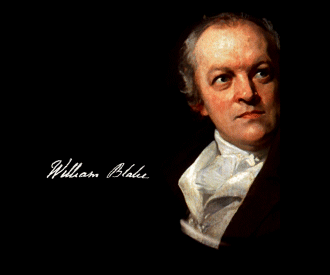
William Blake (November
28, 1757–August 12, 1827) was an English poet, painter, and
printmaker. Largely unrecognised during his lifetime, his work is
today considered seminal and significant in the history of both
poetry and the visual arts. He has often been credited as being
the most spiritual writer of his time.
According to Northrop Frye, who undertook a study of Blake's
entire poetic corpus, his prophetic poems form "what is in
proportion to its merits the least read body of poetry in the
English language." Others have praised Blake's visual
artistry, at least one modern critic proclaiming Blake "far
and away the greatest artist Britain has ever produced."
While his visual art and written poetry are usually considered
separately, Blake often employed them in concert to create a
product that at once defied and superseded convention. Though he
believed himself able to converse aloud with Old Testament
prophets, and despite his work in illustrating the Book of Job,
Blake's affection for the Bible was belied by his hostility for
the church, his beliefs modified by a fascination with Mysticism
and the unfolding of the Romantic movement around him.[2]
Ultimately, the difficulty of placing William Blake in any one
chronological stage of art history is perhaps the distinction
that best defines him.
Once considered mad for his single-mindedness, Blake is highly
regarded today for his expressiveness and creativity, and the
philosophical vision that underlies his work. As he himself once
indicated, "The imagination is not a State: it is the Human
existence itself."